
Emergency Roof Repairs in Exeter
Water coming through the ceiling. Slates in the road. A section of ridge gone in the night. When the roof has failed rather than worn, the job is to stop the water first and have the proper repair done once the weather has cleared. Tell us it is urgent when you call and we treat it as urgent.
What Happens When You Call
We are honest about what an enquiry service can and cannot do in an emergency, because it matters more here than anywhere else on this site.
We prioritise it. An enquiry marked as water coming in goes to the front of the queue and to a roofing firm covering your area that takes emergency work.
They call you back fast. During working hours that means quickly. Outside working hours you will get a call back the next working day. We do not run a night line and we will not promise one.
Make-safe first. The first visit is usually about stopping the water: a tarpaulin, temporary sheeting, refixing what can be refixed from a ladder, or clearing the outlet that caused it. A proper repair follows when the roof is dry and the weather has settled.
Then a proper quote. Once the roof is safe, the roofer looks properly and quotes for the permanent repair. You are not committed to using them for it.
We do not carry out the work ourselves, and we do not inspect or approve the firm we pass you to. In an emergency it is still worth asking to see their public liability insurance before they go up.
What You Can Safely Do Right Now
Catch the water. Buckets under the drip, and a towel under the bucket. If a ceiling is bulging with water, pierce it with a screwdriver over a bucket to let it drain before it comes down on its own.
Move things. Furniture, electronics and anything under the leak. Turn off the power to a room if water is anywhere near a light fitting.
Photograph everything. Damage inside and out, from the ground, with the date. Your insurer will want it, and so will the roofer's report.
Note the storm. Which night, which named storm if there was one. Buildings insurance generally covers storm damage but not wear, and the difference is decided by evidence.
Stay off the roof. A wet slate roof after a gale is not somewhere to be, and a fall costs more than any repair. Do not send a family member up either.
Check the gutters from the ground. If water is pouring over the front edge of a gutter rather than down the pipe, the emergency may be a blockage rather than the roof.
Storm Damage Across Exeter and Devon
Roofing enquiries here roughly double between September and March. Exeter sits close to the Atlantic coast and takes each system before most of the country does, and the estuary towns take it first of all.
On the coast and the estuary. Exmouth, Dawlish, Teignmouth, Topsham and Lympstone see the worst of the wind. Slates and ridge tiles lift, aerials come down through roofs, and salt-weakened fixings let go.
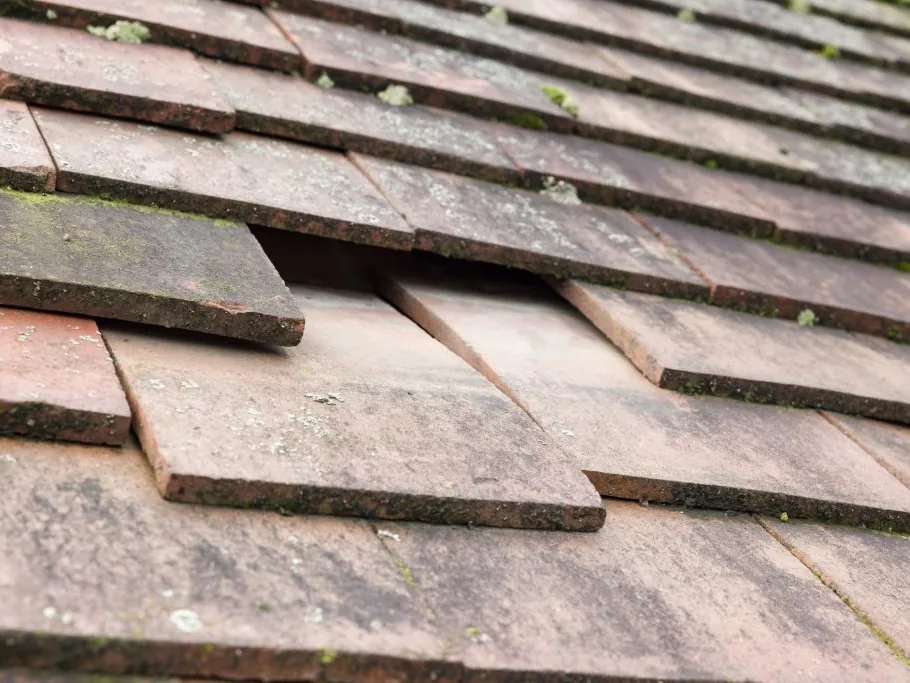
On the older streets. Across the city centre, Heavitree and St Thomas, a storm finds the slates whose nails were already gone. One slipped slate after a gale often means several more are loose.
On the estates. Wind gets under the edge of an interlocking tile roof and lifts a run of them from the verge. Where a dry-verge clip has failed the tiles go one after another.
Flat roofs. A lifted lap on a felt roof is a sail. Once the wind is under it the covering can peel back in one gust.
Trees. Devon's lanes and older suburbs are full of mature trees, and a branch through a roof is the one emergency that cannot wait for morning to be made safe.
Insurance and Storm Claims
Most buildings policies cover storm damage and sudden accidental damage. They do not cover damage that the insurer can argue was already there, and that is the whole argument in most disputed claims.
So the roofer's written report matters. It should say what failed, why, and how the weather caused it, in plain terms. Keep receipts for the emergency work; reasonable make-safe costs are normally recoverable. And do not delay the permanent repair for months, because an insurer can argue that later damage was your failure to act.
How It Works
Call and say it is urgent, or use the form and mark it as water coming in. We pass it to a roofing firm covering your area that takes emergency work, and they call you back. We do not do the work ourselves and we do not inspect or approve the firm that does. Free, no obligation, and outside working hours the call-back is the next working day.
Related Services
Once the roof is safe, the permanent work is a roof repairs job or, if the covering has failed across a slope, a roof replacement. A stack that has shed masonry is covered under chimney repairs, and a gutter that caused the flood under guttering, fascias and soffits.
Areas We Cover
Emergency enquiries from across Exeter, the estuary towns, the coast from Exmouth to Teignmouth, and out to Honiton, Newton Abbot and Tiverton. see all service areas
Common Questions
Can a roofer come out tonight?
We cannot promise that, and we will not. Emergency enquiries are prioritised and passed to a firm that takes urgent work; outside working hours you will hear back the next working day. In the meantime the steps above will limit the damage.
Will a temporary repair be charged separately?
Usually, yes. The make-safe visit is priced on its own and the permanent repair is quoted afterwards. Keep the receipt for your insurer.
Should I claim on insurance for a few slipped slates?
Often not. A small repair can cost less than your excess and a claim can affect your premium. Get the repair quoted first, then decide.
Get a Free Quote for Emergency & Storm Damage
Describe the job and we will hand it to a roofing firm covering your area.